including
Woolwich & Districts including
Woolwich & Districts
|
Woolwich and districts
Shops & Streets, Woolwich

Hog
Lane, c.1888 Photo: Greenwich Heritage Centre
(Click photo for larger view.)

Beresford
Square c.1900. Photo: Greenwich Heritage Centre
(Click photo for larger view.)

Beresford
Square c.1900. Photo: Greenwich Heritage Centre
(Click photo for larger view.)

Close-up
of the Horse Drawn tram. Photo: Greenwich Heritage Centre
(Click photo for larger view.)

Royal
Artillery Barracks c.1900. Photo: Greenwich Heritage Centre
(Click photo for larger view.)
(The Royal Military Academy Woolwich
was established in 1741 during the reign of King
George II and the Royal Military College in
1800. The Barracks, locally known as the Red
Barracks, were unusual in that the rooms opened
on to a veranda. I am told there was a story
that the plans had been mixed up and the
barracks built at Woolwich were originally
planned for abroad, most probably India.
The barracks is where both my grandfather Thomas
Wilson (as an Army Instructor) and my father,
Jack Raymond Riches attended the Military
College of Science. These barracks were in
Francis Street, Woolwich. When my father
mustered at the age of 18, he became an
Artificer, Royal Artillery. He then joined the
Ordnance Corp.
My mother's eldest brother, Robert Alfred White,
went there as a cadet at the age of 14. He
appears in uniform in the photograph of Margaret
Anderson Wilson and all her seven children -
Lorna Chudasama.

Postcard of "Red Barracks" Photo: Lorna
Chudasama.
“To the south-west of the Arsenal
Station are the Army Service Corps Barracks, the
garrison church of St. George, and the Royal
Artillery Institution (natural history
collection, armour and weapons, library, etc.).
To the west of these, on the north side of the
Common, are the large Royal Artillery Barracks,
in front of which is a tank, a captured German
gun, a huge brass gun captured at Bhurtpore in
1828, and a Crimea monument. Between this and
the Dockyard station are the Red Barracks and
the Ordnance College, where officers are trained
for staff appointments.
Woolwich Common, extending for about 1 mile to
the south, is used for exercising troops. On its
north-west side is the Royal Military
Repository, where artillerymen are trained in
serving heavy guns and instruction is given in
pontooning. On the highest point is the Rotunda
(open free daily, 10-12.45 and 2-4 or 5; Sunday
2-4 or 5), originally built as the outer casing
of the tent in which the Prince Regent
entertained the Allied sovereigns in 1814 in St.
James's Park. It now contains an important
Museum of Artillery (catalogue 1/6): designs and
specimens of artillery in iron and brass,
firearms from the earliest period, swords,
defensive armour, Oriental arms, weapons of the
bronze and stone ages, weapons of savage tribes,
rockets, projectiles, models of fortifications,
naval models, German and Allied shells, a French
75mm. gun, etc. On the south-east side of the
Common, beyond the tramway lines, is the Royal
Military Academy, known as 'the Shop,' built in
1805, for the training of cadets studying for
the Royal Artillery and Engineers. In front of
it is a statue of the Prince Imperial, son of
Napoleon III., a Woolwich cadet killed in the
Zulu war of 1879. At the south end of the
Common, beyond the road, is the Royal Herbert
Military Hospital, built in 1865 and named after
Lord Herbert of Lea.

Photo: Lorna Chudasama
To the south of Shooters' Hill lies Castlewood
and Jackwood Park (1925), which includes
Severndroog Castle, a tower (482 feet above
sea-level; admission 1d.) erected to commemorate
the capture of Severndroog on the Malabar Coast
by Sir William James in 1755. An old milestone
(8 miles to London Bridge) nearly opposite the
park-entrance, bears on its reverse the distance
from Ypres (130 miles) and a record of the
British losses in the Salient (1914-18).“
Description supplied by Lorna Chudasama.

St.
George's Garrison Church c.1900. Photo: Greenwich Heritage Centre
(Click photo for larger view.)

Lorna Chudasama (nee Riches):- As you will see
from my baptism certificate (see Early
Family Photos), this is where I was
christened. The church dates from 1863 and the
architect was T H Wyatt. The church had stained
glass windows depicting famous artillery
officers. It also had amazing colourful mosaics
some of which still remain. The church suffered
a direct hit from a VI in 1944.
My mother tells me all the soldiers and their
families were asked to contribute to a
restoration fund which they did. My mother has
often wondered what became of the proceeds as
the Church was not rebuilt but it now a shell of
its former self. However, the church remains
consecrated and open air services are still
conducted on special occasions. I am very
pleased to say I have amongst my archives a
postcard of the Garrison Church (a hollow shell)
as it was in 1955. In 1955 or thereabouts we
were living in married quarters in Nightingale
Place, Woolwich and I was attending Waverley
School.

Railway
Station in Vincent Road c.1900. Photo: Greenwich Heritage Centre
(Click photo for larger view.)

Wellington
Street c.1900. Photo: Greenwich Heritage Centre

Woolwich
High Street c.1905. Photo: Greenwich Heritage Centre
(Click photo for larger view.)

Looking
west from the junction with Hare Street and Nile
Street (Ferry Approach) c.1905. Photo: Greenwich Heritage Centre
(Click photo for larger view.)
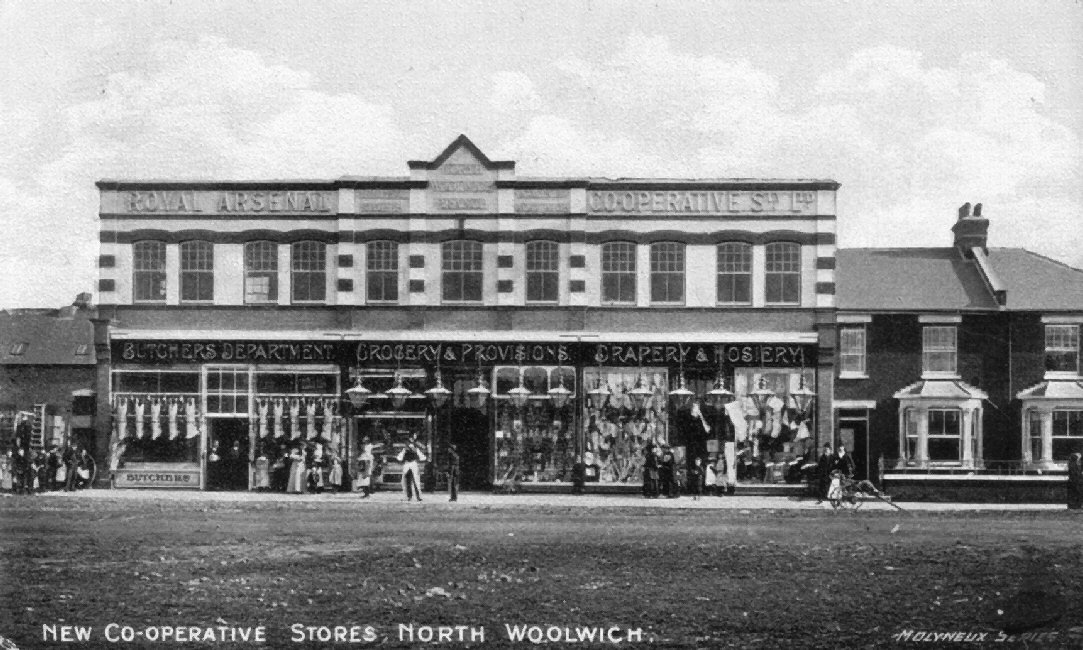
(Photo: Lorna Chudasama from Postcard dated
1906)
(Click on photo for larger view)
This lovely old photo is on a used
postcard dated Dec 28 1906. The wording high on
the Building is Royal Arsenal Co-operative Soc.
Ltd and above shop fronts is the wording
Butchers Department, Grocery & Provisions,
Drapery & Hosiery. I haven't been able to
establish precisely when it opened or its exact
location in Woolwich or whether indeed the
building still stands. I would suspect however,
that it was the Co-operative Store where my
grandmother shopped (with the disapproval of my
grandfather for whatever reason I don't know but
probably political) and valued the dividends.
I have learned that in 1760
co-operative corn mills were built in Woolwich
by dock workers. The dock workers objected to
the high prices charged by mill owners who often
supplied adulterated flour. Quoting from
publishers Adam Matthews:
“Woolwich features significantly in the history
of co-operative action. The first Co-operative
corn mill was founded there in 1760 (well before
the births of Robert Owen (1771-1858) and George
Holyoake (1817-1906), the founding fathers of
the British Co-operative movement) and traded
successfully for over 80 years. Less successful
ventures included a Co-operative butcher's shop
(1805-1811); the Woolwich Bakery Society (1842);
a Co-operative Coal Society (1845); the Woolwich
Co-operative Provident Society (1851); and the
Woolwich and Plumstead Co-operative Society
(1860). But these all showed that the idea of
co-operative action was alive in Woolwich and
paved the way for the establishment of the Royal
Arsenal Co-operative Society [henceforth RACS]
(founded in 1868 as the Royal Arsenal Supply
Association, renamed as the RACS in 1872)”.
One of the links for more information
surrounding the co-operative societies
background is as follows: Go to the publishers web site then
click on “Search” then scroll down and click on
‘LABOUR HISTORY: Series Two: Minute Books &
Papers’ then select which years you want to read
about.
My mother was looking at the
postcard yesterday (24/4/2007) but didn't
recognise it. She told me that quite often when
they were living in the Army flats, she and her
sister Winnie were sent to the Co-op to do the
shopping. One day, on their way back with heavy
bags, three young boys followed them and calmly
helped themselves to the contents of the
shopping bags. My mother and her sister were too
frightened to do anything. They weren't scolded
for losing the groceries but they were never
sent again. Presumably the Co-op where my
grandmother shopped was within walking distance
from Artillery Place.

Hare
Street c.1920. Photo: Greenwich Heritage Centre
(Click photo for larger view.)

Powis Street, pre war. Photo:Barbara Rosam
(Click on picture for larger size)

Stent & Lintorn, Butchers, 27 Powis Street,
Woolwich, early photo. Photo: Sid Blanch
(Click on photo for larger view.)
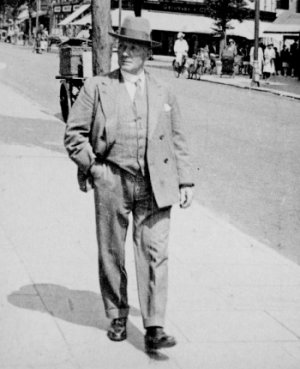
This is a picture of my grandfather Oliver Miles
who worked at Beasley's Brewery. Photo: John
Miles.
The area looks like Powis St to me. I would date
it at 1930.

New Road, Woolwich tram terminus,
c.1930 (from a postcard) Photo: Joe Duncan
(Click on picture for a larger view)

Photo: Brian Willoughby. (Click on
photo for a larger view)
The Woolwich swimming and training club formed a
football team as a means of keeping fit through
the winter months. Mayfield Athletic (named by
me after an Australian football team, God knows
why!)
Back row left to right: Mick Bonners Dad
(trainer/coach) John Pierce, Karl Chapman, Mick
Bonner, Tony Matthews, Brian Willoughby, (?),
Joe Hillier (Manager)
Front Row: Alan Hillier, (?), Ken Pierce, Barry
Puckett, (?)

Maternal (Pearce) family home in
Villas Road, now demolished. Photo 1960/70’s.
Ford car confirms period. Shop was a
greengrocers through 1920/30’s. Photo: Derek
Boswell. See story: The
Blitz Kid Who Stayed Behind

Kingsman Street c.1959. Photo: Greenwich Heritage Centre
(Click photo for larger view.)

Obliesk in Ha Ha Road, Woolwich
Photo: Clare Crawford.
General Interest about Woolwich

Prison Hulks c.1856. Photo: Greenwich Heritage Centre
(Click on photo for larger view)
See
story Prison Hulks at Woolwich

Photo: Clare Crawford
Photo: Clare Crawford

St
Nicholas Church Hall under construction.
Photo: Spencer Morgan (UK) writes
"I found this newspaper page whilst working on
a roof in Torquay, it's from LLOYDS WEEKLY
NEWS - JULY 18 1909"

The Memorial Hospital, Shooters Hill
c.1950 Photo: Roy Earnshaw
(Click on photo for larger view)
See story Memories
of Eglinton Road School

The Bull Hotel, Shootersd Hill c.1950. Photo:
Roy Earnshaw
(Click on photo for larger view)
See story Memories
of Eglinton Road School

Oxleas
meadows, c.1950. Photo: Roy Earnshaw
(Click on photo for a larger view)

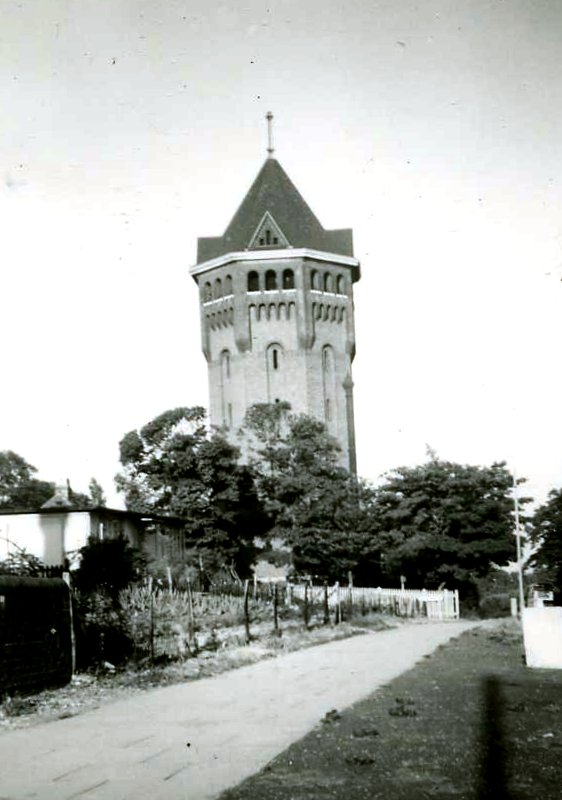
The
Water Tower on top of Shooters Hill. C.1950.
Photo: Roy Earnshaw
(Click
on photo for a larger view)

Another view of the Water Tower
c.1950 postcard. Photo: Joe Duncan
(Clicl on photo for a larger view)

Early postcoard of General Gordon's birthplace,
Woolwich. Photo: Mike Lucas
(Click on photo for larger view)

(Click on photo for very large view)
Looking through the guide of the
south bank exhibition (Waterloo SE1) priced 2/6d
(HM Stationery Office). I spotted this advert
for Siemans.
A lot of people in Plumstead worked for this
company.
Derek Crompton

A crurrent view frm the top of
Shooters Hill Photo: Miram Bastable

Burrage Road 2006. Photo: Joe
Duncan.

Eaglesfield
1970. Photo: Joe Duncan.
(Click on photo for a larger view)

Above and below: Two current views
of the Thames River barriers.
Photos: Joe Duncan (Click on photo for a larger
view)

|