
|
Lorna Chudasama (nee Riches) Remembers
1896 to 1934 : Rippolson Road, Army Flats at Artillery Road and Red Barracks in Francis Street My family’s story starts around 1896 when my great grandfather Robert Anderson Ingram (a Scotsman) left the Westminster Police. He had served some twelve years as a police constable and resigned to take up a job in Woolwich as a Tram Driver. A studio photograph (below)was taken at this time showing my great grandparents Robert and Sarah with their daughter Margaret (my grandmother) and son, also named Robert. My grandmother was about 14 years old and her brother some six years younger.
In 1903 Sarah died at the age of 48. My grandmother at this time had been apprenticed to a tailor. The family were living at 20 Rippolson Road, Plumstead. My great grandfather thought it would be best to send his grieving daughter to stay with her mother’s relatives in Grayshott.. A short time later my great grandfather remarried. There were no children by the second marriage, although the couple adopted a nephew (related to the wife).
My grandmother stayed with her older half sister who was employed as a housekeeper to a wealthy Doctor and his family. The same family employed my grandmother as they valued her sewing skills. A few years later (1908) she married Alfred White. There were four children by this marriage. There is an old photograph taken in 1915 (see below) showing her with the children. Alfred was killed in action the same year. His name appears on a monument at Grayshott. Following the news of her husband’s death, my grandmother returned to Plumstead. She stayed with her father and stepmother briefly, then rented rooms nearby.
My grandmother remembered this five year period in her life as dreadful and hard. To support her young family she took in sewing, doing repairs and alterations at home. She worked all night while the children slept. I am not sure how she met my grandfather (a career soldier) but most of the sewing work undertaken was for the nearby army personnel.
On marrying my grandfather, Thomas Wilson, the family moved to Army Flats (13C Block Artillery Place, Woolwich). My grandfather was an ex miner from Wales, he was also a boxer and for a short while continued boxing for the Army. There are several photographs taken early in my grandfather’s army career, and two taken at different times in the Gym at Woolwich presumably following a team display c1918/19. When my grandparents married (1920), my grandfather was an Army Instructor at the Military College of Science which was housed in the Red Barracks, Francis Street, Woolwich. These barracks were unusual in that the rooms opened out on to a veranda which spanned all sides of the building. It was thought there had been a mix up of plans, and that the barracks had originally been planned for abroad, most probably India.
My mother, Leonora Wilson, and her two sisters were born in Woolwich and baptized at The Royal Garrison Church of St George. All the children, now numbering seven in the family, initially attended the nearby Garrison Infants school and went to Sunday School. My mother and her sister Winnie were in the same class at the Garrison School (see photograph taken c1926) in New Road close to St Peters Church. The three bedroomed army flat must have been very cramped. The four girls shared two double beds (mother was asthmatic and remembers being afraid of her big intolerant sister Margaret who was unkind). The boys shared a double bed in the second bedroom. She remembers her mother being very strict and the children were made to keep as quiet as mice. From an early age they shared the housework. The girls were taught to sew and knit. They knitted their own vests and socks with their mother doing the difficult bits like the heels and necks. Their mother made their dresses, skirts and coats. The cooking was done on a range which was in one room serving as a kitchen, dining room and lounge. There was a toilet but no bathroom in the early years. A large tin bath hung on the wall. This would be taken down and filled with hot water from the copper. Later, the flats had a bathroom added. This was very cleverly done by enclosing the veranda/balcony to each flat and converting it into a bathroom.
My mother’s eldest brother, Robert Alfred White is about 14 or 15 years old and in uniform. He was a cadet at the nearby Royal Artillery Barracks. There is another photograph taken a couple of years later, known in the family as “the three angels”. My grandmother made the girls dresses. The last photograph in this series is of my grandfather and his three daughters, all in similar hats. Again my grandmother made their coats.
My mother and her sisters were taken to visit their grandfather and his wife now living at 51 Rippolson Road. My mother’s father enjoyed visiting his father-in-law as both were partial to a good bottle of whisky which was meant to be shared. In 1932 my great grandfather’s health deteriorated and he died in St Nicholas Hospital.
Around 1934, my grandfather retired from military service. The family left the Army Flats and moved to rented accommodation. My grandfather did, however, continue to work at the Military College of Science and in his civilian role, he began to organize club activities, keeping ruffians off the streets and teaching them to box. 1934 to 1944 : Woolwich - 144 Eglington Road and Military College of Science
On leaving the Army Flats, the family moved to rented accommodation at 144 Eglington Road. The army had helped locate the terraced property which was large and spacious with a garden at the back. Access to the front door was via steps with railings on either side. Inside the house for the first few hours the younger girls raced up and down the stairs, a novelty. Later that year Winnie Wilson started work at a Sports Factory called Gradiges (my mother doesn’t know how its spelt) and the following year in 1935 my mother joined her there. She was aged 14 and it was her first job. (At the outbreak of War the factory closed). There is a photograph of some of the staff taken outside the factory which was a subsidiary of Slazengers.
12 May 1937 was King George V1 and Queen Elizabeth’s Coronation. It was also the day my mother met my father, Jack Riches. He was on leave for the occasion, with a bunch of friends. They were all dressed in “civvies”. My mother also with a group of girls, wouldn’t have spoken to him otherwise as she, the daughter of a soldier, was not allowed to speak to soldiers. The group bumped into each other outside the Rushgrove Gym and introductions were made. My father was at the Military College of Science and mustered at the end of that year in December. There are two photographs of my father taken around this time.
During this year the family were pleased to receive a visit from Walter Blake who was a nephew of Thomas Wilson. Walter had no brothers and sisters and made the long journey from Wales several times to see his uncle.
In 1938 my mother’s eldest sister, Margaret, married a colleague she worked with at Marks & Spencer His name was Stan Powley. A photo of the wedding group was taken in the back garden of 144 Eglington Road. All the family are in the picture apart from Dennis who we think may have taken the photograph. Also in the photo is the family dog Trixie who belonged to Dennis.
There are several photographs taken in the back garden of No. 144 Eglington Road which was one of many properties owned by the Burrage or Burbidge family. The entire terrace was owned by this family who used the house next door as a maintenance office. My grandmother who was quite religious discovered an Aunt of the family had been her Sunday School teacher and following this conversation, the landlords very generously reduced the rent and gave part of the next door garden to my mother’s brother Dennis to cultivate. Dennis was a very keen gardener who grew vegetable as well as prize roses and carnations.
War was declared in September 1939 and the following January 1940 my parents were married in Gosport prior to my father rejoining his unit with the British Expeditionary Force in France. My mother returned to work at the Arsenal. In May that year my father was successfully evacuated from Dunkirk following an initial failed attempt (the first craft sank and he had to swim back to shore). Thomas Wilson had been looking forward to being a grandfather as my mother was now expecting me. Sadly he died unexpectedly in May 1941 of a heart attack. Owing to fears for the safety at the time of my mother’s confinement, the Nursing Home for Mothers and Babies in Samuel Street, Woolwich temporarily relocated to Lord Podmore’s House in Paddock Wood, Tunbridge Wells, Kent where I was born in October 1941. During this year, my mothers’s second eldest brother, Dennis White married Edith and moved into a home of his own. Her eldest brother Robert was already married and living in Army Married Quarters. Her brother Alan was still living at home. Alan had tried to enlist but was refused as he was on the reserve list for Seimans where he worked. Nancy was working for the War Office at the Arsenal.
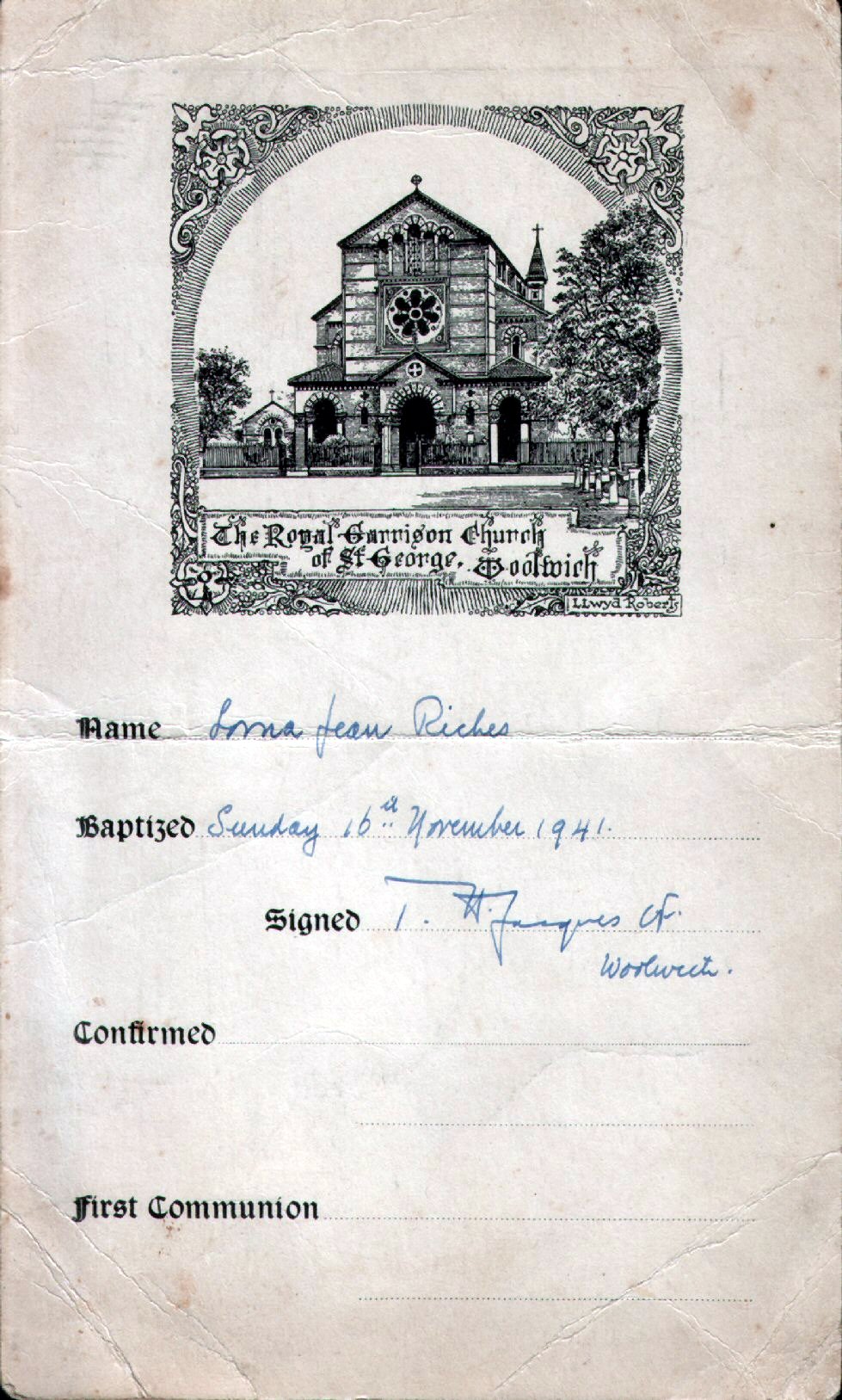
In November 1941 I was baptized at the same St Georges Garrison Church as my mother and her sisters. This Church suffered a direct hit in 1944 and all that remains to this day is a shell (see photograph). The Church is still consecrated and occasional open air services are conducted there.
Some photographs were taken in 1942 of me and my cousin Judith Powley at the front of the house in Eglington Road. In the first, we are sitting on the steps. The railings were later taken down as the materials were needed for the war effort. In the second Judith is taking me for a walk, with our proud grandmother looking on.
In July 1944 my mother’s sister Winnie married Victor Hinds at a Church in Herbert Road. The marriage had been brought forward as Vic had come home on leave. His ship had been damaged in Bombay and had limped home earlier than expected. Despite luxury items being hard to get, the neighbours had rallied round to make the wedding a very special occasion. Between them they provided a splendid feast. There were a lot of sailors at the wedding who made a great fuss of me. Apparently I was very merry, joining in the singing. This rather worried my mother who was heavily pregnant. I do not remember any of this but what happened a few months later is a vivid memory.
Our home at 144 Eglington Road was destroyed by a doodle bug late one night in October 1944. I woke up to a loud rubbling and crashing sound. I was coughing and struggling to get my breath. There was thick dust and debris. My brother was only a few weeks old, something had fallen across his cot but fortunately not on him. I was barely three and remember being carried outside by a fireman. I kept asking what has happened to my Nana’s house. The gas main was alight and there was a lot of activity. The fireman holding me was handed a tin mug of tea from which I took several sips before being placed in an ambulance with my mother and brother. The ambulance was driven by a woman who took us to a hospital. My ears were syringed and my brothers eyes were bathed. His eyelids were swollen. We were relatively unscathed and discharged a few hours later. We were taken to a Rest Centre where we spent a couple of nights. The Rest Centre was at Slade School. Here the Salvation Army gave us soup and distributed items from parcels sent from America. We were given scented soap and talcum powder as well as clothing and bedding. The clothing was new and my baby brother had a beautiful blue knitted suit. My grandmother joined us at the Rest Centre and was given several beautiful sewn quilts which had tickets on them indicating they were gifts from the Ladies Guild of Ohio. My grandmother had not been at home when it was hit, she had gone as usual to the shelter where she slept each night. I had been repeatedly asking what happened to my Nana’s house but no one told me until at last my grandmother said it had been knocked down by the apples and pears. Strangely enough, that explanation satisfied me for a few years. Our home had been looted, so only a few items were salvaged. What remained was badly damaged. We were very fortunate to have survived unhurt, a neighbour in the terrace lost two members of her family. Early in the war, Walter Blake had been seriously wounded and spent years in hospital. Upon recovery towards the end of the war, he returned to Woolwich planning to visit his cousins. He was shocked to find the site had been cleared where the house had stood. He did not know where the family had gone and decades were to pass before contact was re-established. 1945 - 1956 : 74 Shrewsbury Lane, Plumstead and Nightingale Place Woolwich
After we had lost the roof over our heads, we (my mother, brother and myself) stayed temporarily with my grandmother Riches at Gosport. My grandmother Wilson and my mothers sisters Winnie and Nancy moved to a large semi detached house in Plumstead. This was 74 Shrewsbury Lane, Shooters Hill, Plumstead. They were soon joined by my mother’s eldest sister Margaret Powley (now a widow) and my cousin Judith. Aunty Margaret took charge of the household and organized the living arrangements.
We did not join them as in 1945 we moved into Married Quarters at Gosport. The following year we boarded the Britannic (a luxury cruise ship used as a troop carrier) and sailed to join my father in Singapore. Whilst we were in Singapore, my mother’s youngest sister got married and left with her husband for South Africa. Many years were to pass before we saw Nancy again. In 1948 we left Singapore and sailed on the *Empire Windrush (this was a troopship which a few months earlier that year had brought immigrants to Britain). I have fond memories of this ship as I celebrated my seventh birthday (5 October) on board. The Captain invited me and some chosen friends to have a tea party in his cabin and a tour of the bridge. We arrived back in England in time to spend Christmas with my grandmother in Plumstead. It was the first real Christmas I can remember. Judith and I received identical dolls which had two front teeth and closed their eyes. Judith very kindly knocked the teeth out of my doll so we didn’t get muddled up. She need not have troubled as our Aunt Winnie had knitted dresses, hats and booties for the dolls. Mine was dressed in green with a crimson trim. This went some way to pacify me for the loss of my old toys which I had tried to reclaim. The few that had been retrieved from Eglington Road had been given to my little cousin Elizabeth (daughter of Aunty Winnie and Uncle Vic), including a big Airedale dog on wheels which could be sat on or pushed along.
I thought my grandmother’s home in Shrewsbury Lane was the best ever. I liked the gardens with its fruit trees and pretty flowers, the busy road with the horse and carts trundling by. There was the milkman and the rag and bone man calling out. Any steaming horse manure deposited in the road was soon collected by residents for their gardens. We had woods, parks and commons nearby. Up the lane a couple of doors from our house was a tennis club. This was quite noisy in the afternoons. Further down the Lane there was a horse trough and another opposite the fire station. The fire station fascinated me, I would stare at the red doors willing a fire engine to come out. We passed this often as we turned to go down the steep hill to the shops. Although it was a long walk and my grandmother had troublesome ankles, we never caught the bus. I remember thinking my Aunty Margaret was rich. She had a telephone and a lovely carpet in the front room. There were nice ornaments and a television in a cabinet. We were rarely allowed in this room or her dinning room which was next to my grandmother’s sitting room. My Aunty Winnie and Uncle Vic had their own large sitting room which was also used as a dinning room, they always made us welcome. The kitchen was shared, as was the bathroom upstairs. The hot water in the kitchen and in the bathroom was heated by noisy Ascots which frightened me. There was an outside toilet and an upstairs toilet. My grandmother made lovely rice puddings which we had often. She also made bread and butter puddings. I liked anything my grandmother made, particularly the apple pies. My Aunty Margaret occasionally made a fruit cake and I was always surprised at her skill in cutting the slices so thin. We were allowed one slice each. We stayed with my grandmother for a few months. I went to Plum Lane School. The school was at the bottom of a steep hill. Half way down the hill there was a wooden tuck shop. We stopped there to buy sherbet and liquorice. My cousin Bobby (the son of my uncle Dennis White) went to the same school. He was a few months younger than me but in the same class. Bobby lived in a prefab. Each morning we were made to have a large spoon of Malt, I didn’t mind that. We were also made to drink a small bottle of milk which I hated as it was warm (being placed close to the radiators). I thought it smelt and my protests got me into trouble. In Singapore we had chocolate flavoured milk at school which was much nicer.
My cousin Judith went to a different school altogether. She caught a bus to a private convent school, her place funded by the Army. She wore a smart grey uniform with a large grey hat. I liked staying with my grandmother and was very upset when we moved away to Tidworth.
Here I went to the Garrison School for a few months, then we moved to another area in Tidworth. I then went to a small village school close to the Ordnance Depot where we lived. Our house was the only one inside the large Depot complex. My father ran the REME Workshop there. We had a very large garden and we kept chickens and rabbits. These were of course intended to supplement our meat ration and provide us with eggs but I didn’t realize that. Each evening my father with myself and my brother in tow, would take a hessian sack to gather dandelions and clover for the rabbits. The Depot was behind tall double gates which were opened by a guard. In the morning when it was clocking on time, a siren went. The siren went again at the end of the day when it was time for the workers to clock off. The siren always unnerved me. My cousin Judith spent each school holiday with us. I stayed a few weeks with my grandmother during 1951 when my Aunty Margaret took Judith and myself to visit the Festival of Britain. I was very impressed. Our next posting was to Colchester. My brother and I started the Garrison School at Berechurch and found ourselves very disliked by a group of children. I never understood why we were subjected to such hostility and still don’t. We arrived home at the end of the day with torn clothing and bruises. After a few weeks of this, we were both transferred to other schools in the area. Some eighteen months later, my father went to Korea. My grandmother stayed with us for a while as my mother had become unwell. The army children in Colchester whose fathers were in Korea were invited just before Christmas to take part in a special radio show. We recorded messages to our fathers and were entertained by Max Bygraves, Beryl Reid, Peter Brough and Archie Andrews (this latter character was a dummy from the radio series “Educating Archie”). Boards were held up telling us when to laugh and clap. We watched the Coronation on a friends television and at school we were presented with a book called “Royalty in Essex”. I still have mine. Late in 1953 we left England on the TSS Empire Halladale, we were to join my father who was now stationed in Hong Kong. We celebrated Christmas Day on board, the crew put on a splendid party. Late the previous night (Christmas Eve) we had been allowed on shore at Colombo to shop for summer clothes and sandals. Because the ship was in port many shops, lit by oil lamps, had opened specially. We had a military police escort who made sure no one strayed and got lost. We spent a year in Hong Kong in the New Territories (Sek Kong Valley). I went first to the small army school in the village and after passing the Murray House Test (13 plus), I travelled by army truck to a train station the other side of the valley, then caught a train to Kowloon. I was anxious to return home to England particularly as the 20th Field R.A. (to which my father was attached) was due to be posted back to Woolwich. Late in 1954 we boarded the SS Empire Fowey and another Christmas was spent on the high seas.
In January 1955 we arrived back in Woolwich, staying initially with my grandmother at Shrewsbury Lane and then moving to army quarters at Nightingale Place. My Aunty Winnie and Uncle Vic had at this time moved to Eltham with their childen. I started at Waverley School for Girls and my brother went to Bloomfield School.. I lived close enough to walk to my grandmothers and did most weekends. I would have tea in the garden or in her sitting room. She would be knitting and listening to the radio. She never missed Dick Barton, Special Agent. Another favourite of hers was Mrs Dales Diary. The following year we were moved to Colchester again and I started my eleventh school (there was one more school after this, then College in Kenya). My grandmother became ill and we returned to Woolwich to visit her in hospital. She died in 1956. The house at Shrewsbury Lane was now too large for my Aunty Margaret and cousin Judith. They moved to a new maisonette. We visited them in their new home. Sadly, within months of moving, Aunty Margaret was hurt in a car accident and died a few days later. Judith was following a nursing career at the time. My father and my Uncle Bob (Robert White) both offered Judith a home but with the support of her matron, she declined. After a few years in Colchester, we joined my father in Kenya. I only came back to Woolwich once in 1972 for the wedding of Aunty Winnie and Uncle Vic’s second daughter. All the White/Wilson offspring were there apart from my Uncle Bob who had died of natural causes whilst still a serving army officer. His widow and daughters emigrated soon after to South Africa. My Aunty Nancy was at the wedding with her husband and daughter Marilyn, they had returned from South Africa and were living in Hampshire. I was at the wedding with my parents and brother. Also with me was my eldest daughter, Jayshree (see photo) who is the child at the front wearing long white socks. On the left of Jayshree is my brother Jack. Beside my brother (behind Jayshree) is my mother, Leonora Riches. Judith is at the back wearing a large hat, my cousin Elizabeth Henry (nee Hind) is on her left.
I had always regarded my grandmother’s home as my own. It was a familiar welcoming place. It was my anchor. Although it suited some, moving around as often as we did unsettled me and I never felt anywhere else was home.
*The Empire Windrush sank years later in March 1954. We were in Hong Kong at this time and knew several of the army families who had embarked from the Colony. There were also wounded on board from Korea. All the passengers survived having been picked up by the French Navy.
Miscellaneous “Snippets” following lunch with mother ... (January 2007) Today we were looking at lovely bed quilts in the Gift Shop at our local Garden Centre where we have lunch every Wednesday. I remembered and remarked on the lovely patchwork quilts that covered the beds at my grandmothers home at 74 Shrewsbury Lane. Mother said the quilts were all given to us by the Salvation Army at the Rest Centre after my grandmothers home at 144 Eglington Road had been destroyed in 1944. She told me after we had received attention at the hospital, we were taken to the Slade School where we were fed and given a place to sleep. Here the Salvation Army distributed items from parcels received from America. We were given SCENTED soap and talcum powder as well as clothing and bedding. The clothing was new and my baby brother had a beautiful blue knitted suit. The beautifully sewn quilts had tickets on them which indicated they were gifts from the Ladies Guild of Ohio. Mother said she always had wanted to thank the Ladies Guild of Ohio, their thoughtful generous gifts meant such a lot to distressed families. I thought it might still be possible to do so. We were fortunate that apart from losing our home, we were virtually unscathed. My brother who was only a few weeks old had his eyes treated - his eyelids were swollen as a result of the dust. I had apparently inhaled and swallowed dust and my ears had to be syringed. A few days later I was violently sick following constant coughing and my ears were painful and discharging. Discussing this website, our conversation then went back to my mother’s childhood. Mother and her sisters were born at the Military Hospital for Mothers & Babies in Depot Road. She thinks this might have been part of the Herbert Hospital. They lived in Army Flats (C13) in Artillery Place. They had a three bedroom flat which must have been crowded for a family of nine. The four girls shared two beds (mother was asthmatic and remembers being afraid of her big intolerant sister Margaret who was unkind). The boys shared a double bed in the second bedroom. She remembers her mother being very strict and the children were made to keep as quiet as mice. From an early age they shared the housework. The girls were taught to sew and knit. They knitted their own vests and socks with their mother doing the difficult bits like the heels and necks. Their mother made their dresses and skirts. She said the cooking was done on a range which was in one room serving as a kitchen, dining room and lounge. There was a toilet but no bathroom in the early years. A large tin bath hung on the wall. This would be taken down and filled with hot water from the copper. Later, the flats had a bathroom added. This was very cleverly done by enclosing the veranda/balcony to each flat and converting it into a bathroom.They all went to the local Garrison Schools. My mother recently heard from a friend who had returned to Woolwich a few years ago to do a trip down “Memory Lane” to take photographs. This friend said the Army Flats at Artillery Place had now been demolished. This is a photograph taken of staff outside their workplace. This was mothers first job. She was just 14 and the family had left the Army Flats in Artillery Place and moved to 144 Eglington Road. Mother worked alongside her sister Winnie at a Sports Factory close to Artillery Place. The factory was Gradiges (the name might not be spelt correctly) which was a subsidiary of Slazengers. Winnie was not in this photo. Most of the names my mother has now forgotten but she rembers the man on the left in the front row was the Manager, Jack Walker (who was scandalised on seeing washing hanging on the lines on a Sunday). The lady beside him was Margorie Coombes and next to Margorie is Joan (who married Neil Flynn). Neil is not in the photo. My mother doesnt remember any other names apart from the lady next to her (second row on my mother's left) was Florrie Sullivan. My mother thinks the buildings in the background are the barracks. The group are facing their workplace so unfortunately there is no view of the factory which closed on the outbreak of war.
|
||||||||||||||||||||||||||||||||||||||||||||||||||||||||||
 including
Woolwich & Districts
including
Woolwich & Districts


 Thomas Wilson
Circa 1918 Army Gym Team.
Thomas Wilson
Circa 1918 Army Gym Team.


 "Three Angels".
Circa 1927. My mother, Leonora Wilson,
is on the left, Winnie in the middle and
Nancy on the right.
"Three Angels".
Circa 1927. My mother, Leonora Wilson,
is on the left, Winnie in the middle and
Nancy on the right.


 Nancy Olive Wilson
who worked in the office at the Arsenal.
Several times this entailed Nancy
travelling to Wales on assignments.
Nancy Olive Wilson
who worked in the office at the Arsenal.
Several times this entailed Nancy
travelling to Wales on assignments.




 Vic & Winnie
outside the church in Herbert Road but my
mother does not now recall the name of the
church. Apart from my mother’s wedding,
most of the family marriages took place at
this church.
Vic & Winnie
outside the church in Herbert Road but my
mother does not now recall the name of the
church. Apart from my mother’s wedding,
most of the family marriages took place at
this church. 
 Circa 1946: 74
Shrewsbury Lane. This is my cousin
Elizabeth Hind, daughter of Winnie &
Vic.
Circa 1946: 74
Shrewsbury Lane. This is my cousin
Elizabeth Hind, daughter of Winnie &
Vic.




 Lorna &
Judith a bit closer up.
Lorna &
Judith a bit closer up.


